GB.png

An official website of the State of Georgia.
The .gov means it’s official.
Local, state, and federal government websites often end in .gov. State of Georgia government websites and email systems use “georgia.gov” or “ga.gov” at the end of the address. Before sharing sensitive or personal information, make sure you’re on an official state website.
Still not sure?
Call 1-800-GEORGIA to verify that a website is an official website of the State of Georgia.
May 20, 2026
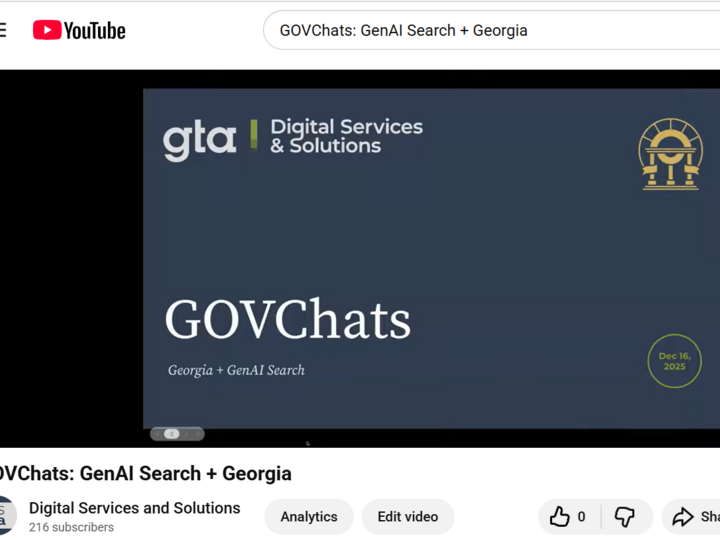
In December 2025 GovChats, we sat down with Gabby Burke, the industry architect focused on health and human services for Google Public Sector. Gabby is part of GPS’s rapid innovation team, where she works directly with federal, state, and local governments on cloud adoption. Beginning in 2025, that now includes a heavy AI component.
Before joining Google in 2024, Gabby served the state of Colorado for more than 10 years. We spoke to Gabby about how even as Generative AI changes the online content experience, the best practices of content strategy and getting your content seen remain largely the same.
We'll be talking a lot about AI Overviews or AI search summaries. AI Overviews are Google's version of AI summaries. When you search, particularly longer searches or how to do certain things, you may have noticed that a summary will now come out on top above your typical results. When we say AI Overview, that's what we're referring to. So how can agencies ensure the accuracy of their information in those AI Overview summaries?
I think it's really important to understand when AI Overviews are triggered. They tend to come up when there's a query that's called a “No Right Answer Query.” So, anything that is more nuanced or more in a gray area, that's what's going to trigger an AI Overview because that gives the opportunity for the AI to kind of summarize the different paths or the actions that might be of interest to the person who's searching.
So, how you can make sure the information stays accurate in the AI Overview summary is to do a couple of different things:
How can agencies combat misinformation or disinformation from unauthorized third-party sites that are being pulled into AI Overviews or even Gen AI answers?
I think disinformation in general is a challenge we all struggle with just by the nature of how the internet has evolved. The core strategy here for state agencies is to be the strongest signal on a particular topic and that really helps to drown out the misinformation problem. This is true for SEO.
With the AI Overviews, it gives you potentially a challenge, but also a really big advantage because government sites are already trusted. As you increase that footprint, it will drown out that noise even more. There's a couple things you can do to respond to those emerging areas of disinformation.
Overall it's a good idea to anticipate the things that are coming out. So keep track of those scam or “scam-lite” things that are percolating in the ecosystem. Create content that actively or proactively debunks that content. You can put a myth-versus-fact page, or if you have something really significant — like I know in our area we have an issue right now that, it's not really fraud, but we have folks who will reach out and say, hey, like you can get a copy of your deed and you just have to pay me $50 or whatever — when in reality, I can pop over to my county office and get that for a $3 printing fee. You can just put it on your page, and that will really help with the AI Overview and for folks in general.
If you're seeing something really fraudulent, you can report inaccurate information specifically in AI Overviews. You can click the three dots in the results over in the righthand side and file a report. You can add a little bit of information about what is causing it, if it's wrong, fraudulent, or inappropriate content, or even if you have an issue with a legal question like someone's inappropriately reproducing your data or misrepresenting it.
You said that government still maintains its advantage in authority that it had in traditional search results with AI summaries. There's a statistic from Pew Research that while government sources, peer-reviewed, or academic sources make up about 2% of traditional search results, right now in AI Overviews it's about 6%. So already there is some of that gain that you're talking about.
Yeah, that totally makes sense. And I think there is some alignment like when we talk about search engine optimization versus AI. It's just a different way of the computer processing information.
The core of search engine optimization has always been this core concept of experience, expertise, authority, and trustworthiness.
We've talked a little bit about how the principles of SEO, search engine optimization, are translating into what's being kind of known as GEO, or generative engine optimization. Can you talk about some of those principles that translate over?
Generative engine optimization is really just an expansion of search engine optimization. The actual principles have really not changed at all. It's just a good opportunity to take another look at how we're applying SEO in government agencies.
From my perspective, the core principles of SEO are experience, expertise, authority, and trustworthiness. That's still the most important thing, and that's going to be weighted even more heavily when you think about topics that are considered your money, your life. That's anything about financial stability, safety, welfare, well-being — all of those topics are going to prioritize expertise and authority even more than if I'm just searching for sweaters.
AI models are going to prioritize authoritative content in the AI Overview the same way it does organic search results.
How does the LLM think? Well, it's looking for clarity. It's looking for something it can understand. So it's going to do better with lists and processes and really clear content that's appropriately labeled.
In the same way, you can also use tools like Google Trends to see what people are looking for. Should I be spinning up a new page or producing more content if there's something really of-the-moment that you want people to have access to? Make sure that you're addressing those topics so you're being prioritized in those AI Overviews.
We say to agencies, look at what people are searching in your internal search on your website just to get an idea of what people look at — your most popular pages, what are people interested in, what are they coming for, what do they have questions about, what are they calling about, where are the points of confusion, or maybe those points of friction, and what language are they using?
And one area where Gen AI is actually, from my perspective in HHS, enormously helpful is it can handle that context. It can understand the different ways that people might interact or might ask questions. Because yeah, we can try to shift language over time, but there's a lot of outdated or even emerging new terminology that we might not be able to hold on our site. AI can really help with that context and make sure that you're casting a wider net as people interact with the system in language that makes sense to them.
That's a big thing with AI: intent. It's looking for intent. It's not necessarily literally what you're putting in there or what you're saying. It's looking past that to what you're actually trying to accomplish.
Exactly. Another really interesting example for HHS is a lot of folks don't totally understand the difference between Medicare and Medicaid. And if you were searching Georgia Medicare, AI might be able to say, did you actually mean the Medicaid program? Because Medicare is a federal program. It can help navigate some of those things that might be really hard to do in a more structured search result.
As we're talking about the shift from SEO to GEO, there's been a lot of discussion about this “Google Zero” concept, which is the idea that eventually Google will stop sending traffic to third party websites and all of the information will be presented to the user within Google's platforms via AI technology. There are going to be other AI browsers like Atlas. This will probably mean that fewer people are going to websites. They're interacting with maybe a Gen AI tool or browser and that's giving them what they need without going directly to that website or directly to that source. So as website traffic decreases due to that kind of usage, which organizations are going to be the most impacted by that change?
Yeah, this is definitely going to impact private sector organizations differently than public sector organizations. If I search for women's sweaters, there's probably tens of thousands of results. Some of it might be review videos or blogs or magazine articles. There's such a wide swath of content associated with that. And some of those blogs, if they're not paying attention to this, might take a hit because they focus their business around how many folks are clicking on their particular page, and they might have ads on their page.
That's really different for public sector. You don't really have this kind of market saturation question to consider because in public sector, there's only one Georgia Medicaid. You are the authority on Medicaid in the state of Georgia.
This is an opportunity to meet the moment because the way people interact with the web is changing and I'm really excited that so many state government agencies are thinking about this now.
What do you recommend when you're thinking about the difference affecting public sector? How should public sector shift their thinking?
If we're thinking about what we really want to do for our constituents, like what are our end goals and what impact do we see our agency having, I think there's a really cool opportunity here to make our web content nearer to that. If you think about the private sector commercial side, a digital sales strategy in general is going to be focused on conversions, right? Somebody comes to the page, they saw our content, maybe they saw an ad, they came to the page and they either bought something or signed up for something. There was this outcome that we wanted to have.
We do have conversions in government. We want somebody to do a thing, but it's more about getting people the support they need. It's more about, “Hey, did you renew your driver's license on time or did you pay your property taxes on time?”
AI Overviews might actually help us there because we can do a better job getting that broader reach out with the information that we need to get out the door. So we can shift our measurement strategy a little bit to align with our core values. What do we want people to accomplish and why do we want them coming to our page? I think that's the opportunity here: how can we shift to be more outcome-focused?
So really thinking about: what is the purpose of this content? What do you want people to do, what do you want the outcome to be? And shaping the experience around that.
Yeah, exactly. It's shifting away from this really transactional government to a broader relationship or collaborative type approach to how we expect people to get services. I like that way of thinking about content, maybe a little bit more tactically, and thinking about what is the goal? What are we trying to accomplish here? And being very purposeful about the content that goes out on your website.
Read Part 2, where we discuss content strategy and what really works with SEO, and now GEO.